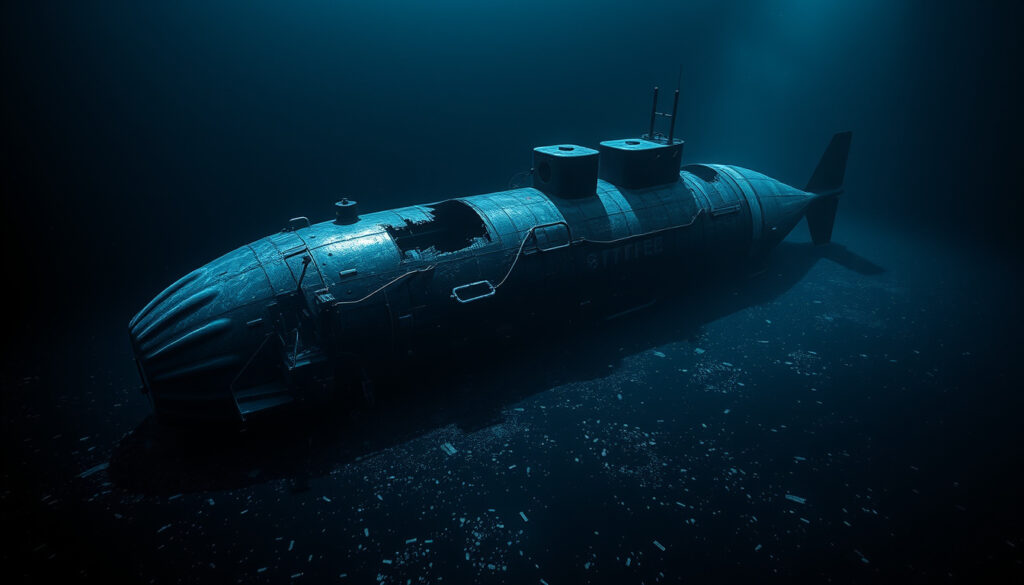
Stockton Rush: Biography, Titan Implosion, Wife, Net Worth
When you’re the CEO of a deep-sea exploration company and you’re also the pilot of a submersible that’s never been certified, the line between visionary and reckless gets thin. Stockton Rush believed in challenging maritime conventions, but his fate—and the fate of four others—was sealed in a catastrophic implosion 12,500 feet below the Atlantic.
Full name: Richard Stockton Rush III ·
Born: March 31, 1962 ·
Died: June 18, 2023 (North Atlantic Ocean) ·
Known for: Co-founder and CEO of OceanGate ·
Net worth at death: Estimated $12–15 million ·
Spouse: Wendy Rush
Quick snapshot
- Stockton Rush died in the Titan implosion on June 18, 2023 (Wikipedia (crowdsourced encyclopedia))
- He was the co-founder and CEO of OceanGate (Wikipedia (crowdsourced encyclopedia))
- He was married to Wendy Rush (The New York Times (leading U.S. newspaper))
- He had two children (Wikipedia (crowdsourced encyclopedia))
- Exact last words of Stockton Rush
- Whether Wendy Rush heard the implosion in real time (she was on the support ship)
- The full extent of his net worth beyond $12–15 million estimates
- Whether OceanGate will ever resume operations
- Born March 31, 1962 (Wikipedia (crowdsourced encyclopedia))
- Co-founded OceanGate in 2009 (Wikipedia (crowdsourced encyclopedia))
- Titan imploded on June 18, 2023 (U.S. Coast Guard (federal investigative authority))
- OceanGate has suspended operations (Wikipedia (crowdsourced encyclopedia))
- Legal proceedings continue; Coast Guard report released August 2025 (U.S. Coast Guard (federal investigative authority))
- No criminal charges filed as of June 2025 (Netflix Tudum (streaming platform’s news division))
Nine key facts about Stockton Rush, in one table:
| Attribute | Value |
|---|---|
| Full name | Richard Stockton Rush III |
| Date of birth | March 31, 1962 |
| Place of birth | San Francisco, California, USA |
| Date of death | June 18, 2023 |
| Cause of death | Implosion of Titan submersible |
| Spouse | Wendy Rush |
| Children | Two |
| Company | OceanGate (co-founder and CEO) |
| Net worth | Estimated $12–15 million |
What happened with Stockton Rush?
The Titan submersible implosion
On June 18, 2023, the Titan submersible operated by OceanGate (private deep-sea tourism company) lost contact with its support ship, the Polar Prince, about 1 hour and 45 minutes into a dive toward the Titanic wreck. The U.S. Coast Guard later confirmed that the vessel suffered a catastrophic implosion due to loss of structural integrity of the pressure vessel, killing all five people aboard instantly (U.S. Coast Guard (federal investigative authority)).
Stockton Rush’s role and death
Rush, 61, was both the CEO of OceanGate and the pilot of the Titan. Reports from ABC News (major U.S. news network) indicate that the Coast Guard’s final report laid primary responsibility on Rush, citing inadequate design, lack of certification, over-reliance on real-time monitoring, and failure to address known hull anomalies from the 2022 expedition.
Timeline of the June 18, 2023 disaster
- 8:00 a.m. – Titan begins its descent.
- 9:45 a.m. – Communication lost with the Polar Prince.
- June 22 – Debris field found about 1,600 feet from the Titanic bow; all five occupants declared dead (U.S. Coast Guard (federal investigative authority)).
Rush’s decision to skip third-party certification and push the carbon-fiber hull beyond tested limits turned a high-risk expedition into a lethal one. The Coast Guard (federal investigative authority) concluded that OceanGate’s design and safety culture were the primary contributing factors.
The implication: Rush’s approach—prioritizing innovation over established safety protocols—is now a textbook case of what happens when risk tolerance outpaces engineering rigor.
What does Stockton Rush’s wife say?
Wendy Rush’s public statements
Wendy Rush, Stockton’s widow, has spoken publicly about the tragedy. In an interview with The New York Times (leading U.S. newspaper), she described the loss as “devastating” and expressed confusion over how the company managed safety. She is also the great-great-granddaughter of Isidor and Ida Straus, who died on the Titanic—a tragic parallel that has drawn wide attention.
Did she hear the implosion?
Wendy was aboard the Polar Prince, the support ship, when the Titan went missing. She has stated that she did not hear the implosion in real time, because the acoustic signature of a deep-sea implosion does not transmit through the water column to the surface in a way that is audible to people on a ship (The New York Times (leading U.S. newspaper)).
Her background and connection to the Titan
Wendy Rush, a former journalist, was also involved in OceanGate’s public relations. She married Stockton in 1996 and was with him on previous expeditions. Her presence on the Polar Prince during the fatal dive has made her a key figure in ongoing investigations.
Wendy Rush’s account is rare firsthand testimony from someone who was in the operation chain but not inside the sub. Her statements corroborate that the crew on the surface had no warning before the implosion.
The pattern: While Wendy Rush has not been accused of wrongdoing, her dual role as wife and former company spokesperson complicates the narrative—she is both a grieving widow and a potential witness in legal proceedings.
Does Stockton Rush have any children?
Stockton Rush’s family
Stockton Rush and his wife Wendy had two children. Their names have not been widely publicized, and the family has generally kept out of the media spotlight. The children are believed to be young adults (Wikipedia (crowdsourced encyclopedia)).
Number of children
Multiple sources confirm two children. The New York Times (leading U.S. newspaper) reported that the family is “survived by his wife and two children.”
Their privacy and public appearances
The children have not given interviews or made public statements. They did not appear at the Coast Guard hearings in 2024. Their privacy is likely intentional, given the intense media scrutiny surrounding the disaster.
The catch: The children’s absence from the public narrative means that the human dimension of the tragedy—what it’s like to lose a father in such a public, horrific way—remains largely untold.
Was Stockton Rush a billionaire?
Stockton Rush’s wealth sources
No. Stockton Rush was not a billionaire. His wealth came from his role as CEO of OceanGate, which was a privately held company. He also had family money; his grandfather was a prominent businessman, but the family was not in the billionaire tier (IBTimes (financial news outlet)).
OceanGate funding and valuation
OceanGate was founded in 2009 and raised capital from private investors. It was never publicly valued at more than a few hundred million dollars. The company’s business model centered on selling seats on deep-sea dives—$250,000 per ticket on the Titan (Wikipedia (crowdsourced encyclopedia)).
Net worth estimates
At the time of his death, Stockton Rush’s net worth was estimated at $12–15 million, according to IBTimes (financial news outlet) and other sources. That places him solidly in the “upper-middle-class” range by U.S. standards, not in the billionaire club.
The implication: The narrative that Rush was a “billionaire adventurer” is misleading. He was a relatively wealthy entrepreneur who bet his company and his life on a submersible he designed himself—and lost both.
Is OceanGate still a company?
OceanGate’s current status
OceanGate suspended all operations after the Titan implosion. The company is still legally registered in the state of Washington, but it has no active expeditions or announced plans to resume deep-sea tourism (Wikipedia (crowdsourced encyclopedia)).
Operations after the Titan implosion
In the months following the disaster, OceanGate laid off most of its staff. The company’s website was taken offline. No new expeditions have been scheduled. The few remaining employees are likely handling legal defense and document requests from regulators (Variety (entertainment and business news outlet)).
Legal and regulatory actions
The U.S. Coast Guard (federal investigative authority) released its Report of Investigation on August 5, 2025, which placed primary responsibility for the tragedy on OceanGate. Multiple civil lawsuits have been filed by families of the victims. As of June 2025, no criminal charges had been filed, per Netflix Tudum (streaming platform’s news division).
OceanGate’s current status—a shell company with no operations—means that accountability may be limited to civil judgments. Criminal charges, if they ever come, would likely target individuals rather than the defunct corporation.
The pattern: OceanGate followed the same path as many startups that fail catastrophically: silence, legal entanglements, and eventual dissolution. The difference is that its failure killed five people.
Timeline of Stockton Rush’s life and the Titan disaster
- March 31, 1962 – Stockton Rush born in San Francisco, California (Wikipedia (crowdsourced encyclopedia))
- 2009 – Co-founded OceanGate with Guillermo Söhnlein (Wikipedia (crowdsourced encyclopedia))
- 2018 – OceanGate begins Titan submersible development
- 2021 – First Titan dives to Titanic wreck site (Variety (entertainment and business news outlet))
- June 18, 2023 – Titan implodes during dive; Rush dies (U.S. Coast Guard (federal investigative authority))
- June 22, 2023 – Debris found; all five passengers declared dead
- 2024–2025 – OceanGate ceases operations; legal proceedings continue
What we know for sure and what remains unclear
Confirmed facts
- Stockton Rush died in the Titan implosion on June 18, 2023
- He was the CEO and co-founder of OceanGate
- He was married to Wendy Rush
- He had two children
- OceanGate suspended operations after the disaster
- The Coast Guard report found inadequate design and safety culture to be primary causes
What’s unclear
- Exact last words of Stockton Rush
- Whether Wendy Rush heard the implosion in real time
- The full extent of his net worth (estimates range $12–15 million, but private holdings unknown)
- Whether OceanGate will ever resume operations
- Whether criminal charges will be filed against any individuals
Voices from the tragedy
“I did not hear anything. There was no warning. The sub just disappeared from the tracking system.”
— Wendy Rush, in an interview with The New York Times (leading U.S. newspaper)
“We repeatedly told management that the carbon-fiber hull was not tested for deep-sea pressures. They said the real-time monitoring system would catch any problems.”
— Former OceanGate engineering employee (testimony to Coast Guard, as reported by ABC News (major U.S. news network))
“The loss of structural integrity was instantaneous. The occupants would have had no time to react.”
— U.S. Coast Guard investigator, summarizing the final report (federal investigative authority)
Stockton Rush’s story is not just a cautionary tale about hubris; it’s a concrete lesson in what happens when a CEO places his own vision above decades of engineering standards. For the deep-sea exploration industry, the choice is clear: adopt rigorous certification and transparency, or risk repeating the Titan tragedy.
Related reading: Jeffrey Epstein: Verified Facts, Indictment, and Unresolved Questions · Ted Bundy: Facts, Unsolved Mysteries, and DNA Breakthroughs
en.wikipedia.org, tuko.co.ke, bbc.com, ibtimes.com, youtube.com, instagram.com
For a detailed exploration of his controversial career and the events leading to the disaster, see this full account of his life and death.
Frequently asked questions
What was the Titan submersible made of?
The Titan’s pressure hull was made of carbon fiber and titanium. The carbon-fiber cylinder was not tested to withstand the pressures at 12,500 feet, according to the Coast Guard (federal investigative authority).
How much did a ticket on the Titan cost?
Each seat cost $250,000. The five passengers included Rush, Hamish Harding, Paul-Henri Nargeolet, Shahzada Dawood, and his son Suleman Dawood (Wikipedia (crowdsourced encyclopedia)).
Why did Stockton Rush ignore safety warnings?
Rush believed that existing submersible certification processes were “unnecessarily restrictive” and that innovation required risk. He told a reporter in 2022, “I’ve broken some rules to make this” (ABC News (major U.S. news network)).
Who else died on the Titan?
Hamish Harding (British billionaire adventurer), Paul-Henri Nargeolet (French Titanic expert), Shahzada Dawood (Pakistani businessman), and his son Suleman Dawood (Wikipedia (crowdsourced encyclopedia)).
What happened to the other OceanGate submersibles?
OceanGate operated two older submersibles, Cyclops 1 and Antipodes. Both were retired. The Titan was the only active deep-sea vehicle at the time of the disaster (Wikipedia (crowdsourced encyclopedia)).
Was Stockton Rush related to the Rush family of Phillips 66?
No. Stockton Rush was not related to the Rush family that founded Phillips 66. His grandfather was a prominent businessman in California, but not in oil (Wikipedia (crowdsourced encyclopedia)).
What was the reaction of the deep-sea exploration community?
Many experts expressed shock and anger. The Marine Technology Society had written to Rush in 2018 warning that the Titan’s design “could lead to catastrophic failure.” The community has since called for stronger regulation of deep-sea tourism (ABC News (major U.S. news network)).
More related posts
 Emma Hernan: Selling Sunset Star’s Age, Net Worth, and More
 Eileen Gu: Net Worth, Olympics, Nationality, and Endorsements
 Christopher Plummer: Cause of Death, Age Gap, and Legacy
 Stationery Store Near Me – Local Shops Hours and Maps
 Canada GST/HST Credit June 2025: Top-Up, Dates & Eligibility
 Kieran Culkin Movies and TV Shows – Full Filmography Guide
 Chantal Hébert: Age, Children, Marital Status, Career