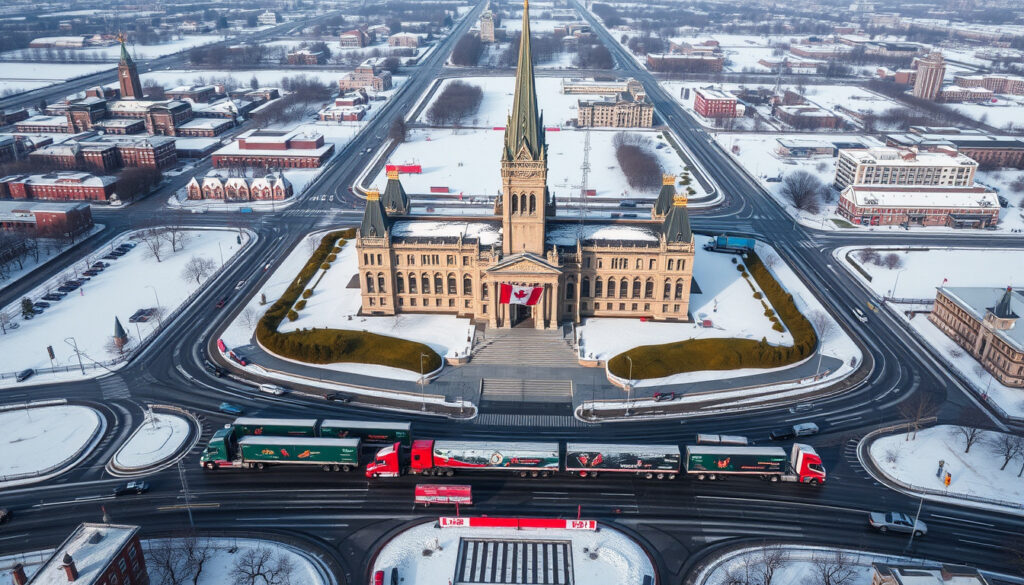
Lockdown Ottawa Parliament Hill – Freedom Convoy Timeline Explained
The Ottawa Parliament Hill lockdown refers to the three-week occupation of downtown Ottawa beginning January 28, 2022, when thousands of protesters descended on Canada’s capital as part of the Freedom Convoy movement. The protest, which gridlocked city streets and paralyzed government operations, became one of the most significant domestic political crises in recent Canadian history and prompted an unprecedented federal emergency response.
What began as a demonstration against cross-border trucker vaccine mandates evolved into a broader challenge to pandemic restrictions, drawing participants from across the country and dominating national headlines for weeks. The occupation ended February 21, 2022, following police enforcement operations backed by emergency powers never before invoked in Canada.
What was the Ottawa Parliament Hill lockdown?
The Ottawa Parliament Hill lockdown was the central event of the 2022 Freedom Convoy protests, characterized by a sustained occupation of the area surrounding Parliament Hill in Ottawa, Ontario. Convoys of trucks, cars, and other vehicles arrived starting January 28, creating an improvised protest zone that would last nearly three weeks.
January 28, 2022
3 weeks
Parliament Hill, Ottawa
Eviction via Emergencies Act
Protest origins
The convoy originated from opposition to a January 15, 2022, federal mandate requiring Canadian commercial truck drivers entering from the United States to be vaccinated against COVID-19 or face quarantine requirements. The policy affected thousands of cross-border truckers, sparking immediate backlash from industry groups and trucking associations. Within days, the protest movement organized online fundraising campaigns and coordinated convoys departing from multiple provinces, drawing participants well beyond the trucking community.
Organizers, including James Bauder, who had previously attempted a smaller convoy operation, built momentum through social media platforms, framing the protest as a matter of personal freedom and government overreach. The movement quickly expanded its demands beyond trucker-specific vaccine rules to call for the elimination of all COVID-19 public health measures nationwide.
Key demands
Protesters broadly demanded the removal of all pandemic-era restrictions, including vaccine passports, masking requirements, and gathering limits. Some participants framed the movement as a “freedom movement” rather than an anti-vaccine protest, emphasizing opposition to government mandates perceived as authoritarian. Criticism of Prime Minister Justin Trudeau’s leadership featured prominently in speeches and signage throughout the occupation.
While initially focused on trucker vaccine mandates, the Freedom Convoy attracted participants with diverse grievances related to pandemic restrictions. Public opinion remained divided throughout the occupation, with supporters viewing it as legitimate protest and critics describing it as an illegal blockade.
- First use of Canada’s Emergencies Act for a domestic situation since its 1988 introduction
- Hundreds of arrests made during the February 21 clearance operations
- Over 30 commercial vehicles seized by Ontario’s Ministry of Transportation
- Border blockades accompanied the Ottawa occupation, including closure of the Ambassador Bridge connecting Windsor, Ontario, to Detroit, Michigan
- Ottawa Police Chief Peter Sloly resigned amid criticism of the policing response
- The Rouleau Inquiry examined the federal government’s decision to invoke emergency powers
| Fact | Details | Source |
|---|---|---|
| Start Date | January 28, 2022 | Public Safety Canada |
| End Date | February 21, 2022 | Public Safety Canada |
| Duration | 24 days | Multiple sources |
| Peak protesters | Approximately 3,000 on January 30 | Public Safety Canada |
| Arrests | Hundreds during clearance operations | Ottawa Police Service |
| Vehicles seized | Over 30 commercial vehicles | Ministry of Transportation |
When did the Ottawa convoy occupation start and end?
The Ottawa convoy occupation began January 28, 2022, when the first convoys reached downtown Ottawa following cross-country journeys that started January 22. The protest officially ended February 21, 2022, when police completed clearance operations following nearly three weeks of occupation.
Key dates
The western convoy entered Ontario on January 25, joined by additional convoys from Windsor, Fort Erie, and other locations by January 27. On January 28, convoys arrived in Ottawa with an initial rally on Parliament Hill, prompting Nova Scotia to ban highway gatherings. By January 29, thousands had gathered and federal assistance for policing was requested. Approximately 3,000 protesters gathered around Parliament Hill on January 30, when organizers held a news conference to outline their demands.
The situation intensified February 5–7, when farm tractor convoys arrived and the City of Ottawa declared a state of emergency. February 14 brought the federal government’s pivotal response: the declaration of a Public Order Emergency under the Emergencies Act. By February 20, police had fenced off the Parliamentary Precinct following advances, maintaining a heavy presence. The occupation ended February 21 when police cleared the remaining protesters.
Major events
Throughout the occupation, downtown Ottawa experienced significant disruption. Convoy vehicles, including large trucks, blocked streets while protesters set up encampments featuring hot tubs, bouncy castles, and temporary structures. The persistent honking of horns became a defining characteristic of the protest, generating complaints from residents and businesses. Parallel blockades emerged at border crossings, including the Ambassador Bridge between Windsor and Detroit, which was closed February 7–9, disrupting trade between Canada and the United States.
The Ambassador Bridge closure during February 7–9 affected thousands of vehicles crossing between Ontario and Michigan daily. The blockade contributed significant economic pressure alongside the Ottawa occupation and factored into the federal government’s decision to invoke emergency powers.
How did authorities respond to the Parliament Hill protest?
The federal government’s response to the Parliament Hill protest evolved alongside the escalating situation. Initial efforts focused on requesting additional policing resources, but the spread of blockades to border crossings prompted more aggressive measures. Prime Minister Justin Trudeau’s administration ultimately invoked extraordinary powers that had never been used since the legislation’s creation.
Police actions
Ottawa police initially struggled to manage the thousands of protesters who arrived in late January. By January 31, officers were significantly outnumbered as the occupation became established. The Ottawa Police Service requested federal assistance, leading to the eventual deployment of officers from the Ontario Provincial Police and other jurisdictions. Police Chief Peter Sloly resigned amid criticism of the handling of the protest, with city officials testifying later about the challenges faced during the occupation.
The eventual enforcement operation on February 21 involved hundreds of officers moving methodically through the occupation zone, arresting remaining protesters and towing vehicles. The police presence remained heavy following clearance, with the Parliamentary Precinct surrounded by fencing.
Emergencies Act invocation
On February 14, 2022, Prime Minister Trudeau announced the invocation of the Emergencies Act, marking its first use in Canadian history. The act granted the government authority to freeze protest-related bank accounts through FINTRAC, authorize the towing of vehicles, and strengthen police enforcement capabilities. The House of Commons approved the measure February 21, with the Senate debating it February 22.
The emergency declaration was revoked February 23, 2022, after police successfully cleared the Ottawa occupation and border blockades. The measure proved temporary but represented a significant expansion of federal emergency authority.
The Emergencies Act replaced the War Measures Act in 1988. Before February 2022, no Canadian government had ever invoked the new legislation for any situation, domestic or international. The Public Safety Canada briefing materials document the legal basis and implementation of the emergency powers.
Who were the key leaders and what was the outcome?
The Freedom Convoy involved multiple organizers who coordinated the cross-country convoys and managed communications with participants and media. Tamara Lich emerged as one of the most prominent figures, addressing crowds from the stage near Parliament Hill and participating in press conferences throughout the occupation.
Main organizers
Tamara Lich served as a principal organizer, appearing at rallies and helping to coordinate logistics for the protest. Chris Barber represented another key organizer, with both individuals becoming faces of the movement. The convoy drew inspiration from organizer James Bauder’s earlier, smaller-scale convoy efforts that preceded the January 2022 mobilization. The organizational structure remained loosely defined, with various individuals contributing to fundraising, logistics, and public communications.
Legal aftermath
By the end of the protests, hundreds of arrests had been made in connection with the occupation and related blockades. Over 30 commercial vehicles were seized by Ontario’s Ministry of Transportation. Tamara Lich faced charges including mischief and counseling mischief for her role in the protest. As of available records through 2023, the legal proceedings remained ongoing, with the Rouleau Inquiry examining the federal government’s use of emergency powers during 2022 and 2023.
The inquiry heard testimony from officials including Ottawa Mayor Jim Watson, who addressed questions about policing failures during the occupation. The examination of the government’s decision-making process and the adequacy of the emergency response continued through 2023, with final outcomes for individual protesters varying based on charges and legal proceedings.
A chronological account of the Parliament Hill occupation
The following timeline outlines the progression of events during the Freedom Convoy occupation of Ottawa, from the initial arrival of convoys through the final clearance operation.
- January 22, 2022 — Convoys depart from various locations across Canada, beginning the journey to Ottawa
- January 28, 2022 — Primary convoys arrive in Ottawa; initial rally held on Parliament Hill
- January 29, 2022 — Thousands gather; federal assistance requested for police
- February 5–7, 2022 — Farm tractor convoys arrive; Ottawa declares state of emergency
- February 7–9, 2022 — Ambassador Bridge border crossing closed
- February 14, 2022 — Federal government invokes Emergencies Act for first time in Canadian history
- February 20, 2022 — Police fence off Parliamentary Precinct; heavy security presence maintained
- February 21, 2022 — Police clear remaining protesters; occupation ends after 24 days
Confirmed facts versus ongoing questions
The Freedom Convoy generated significant public debate, with some claims verified and others remaining contested or unresolved. Understanding what is established versus what remains uncertain helps clarify the historical record.
| Established information | Information that remains unclear |
|---|---|
| Police cleared Ottawa occupation by February 21 | Precise total number of arrests across all jurisdictions |
| Emergencies Act invoked February 14, revoked February 23 | Specific details regarding foreign funding sources |
| Border blockades included Ambassador Bridge closure February 7–9 | Final resolution status of Tamara Lich case beyond 2023 |
| Occupation lasted approximately 24 days | Long-term political impact on federal-provincial relations |
Historical context and significance
The Freedom Convoy occupation represented an extraordinary moment in Canadian political history. Prior to 2022, no Canadian government had ever invoked the Emergencies Act, even during significant domestic crises. The protest also illustrated the polarized nature of public opinion regarding pandemic policies, with supporters and opponents holding fundamentally different views of the legitimacy and impact of the demonstration.
The occupation’s impact extended beyond Ottawa. Border blockades at the Ambassador Bridge and other crossing points affected trade flows between Canada and the United States, generating concern from business groups and international observers. The protest movement drew inspiration from similar demonstrations in other countries while maintaining distinctly Canadian characteristics in its organization and demands.
The subsequent Rouleau Inquiry examined the circumstances surrounding the emergency declaration, providing a formal record of government decision-making during the crisis. The inquiry’s findings have informed ongoing discussions about emergency powers legislation and intergovernmental coordination during civil emergencies.
Official statements and sources
Several official sources documented the events and government response during the Freedom Convoy occupation.
The Emergencies Act was invoked on February 14, 2022, to restore public order in Ottawa and address the threat posed by the ongoing illegal blockades at border crossings.
— Government of Canada, Department of Justice documentation
The City of Ottawa declared a state of emergency on February 6, 2022, as the protest occupation continued to grow and overwhelm local policing capacity.
— City of Ottawa official communications
The Ottawa Police Service, Public Safety Canada, and the Parliamentary review process all produced documentation relevant to understanding the sequence of events and the government’s legal basis for emergency action.
Summary
The Ottawa Parliament Hill lockdown lasted 24 days, beginning January 28 and ending February 21, 2022. The Freedom Convoy began as opposition to trucker vaccine mandates but expanded into a broader challenge to pandemic restrictions. The federal government’s unprecedented invocation of the Emergencies Act on February 14 provided powers to freeze financial accounts and authorize vehicle towing, leading to the eventual clearance of the occupation. Legal proceedings against organizers, including Tamara Lich, continued beyond the occupation’s end, with the Rouleau Inquiry examining the government’s response. The protest highlighted deep divisions over pandemic policy while testing the boundaries of Canadian emergency legislation.
Frequently asked questions
Were there arrests during the Ottawa protest?
Hundreds of arrests were made during the Freedom Convoy clearance operations in Ottawa. The arrests occurred primarily on February 21, 2022, when police moved through the occupation zone to enforce the removal of remaining protesters. Over 30 commercial vehicles were also seized by Ontario’s Ministry of Transportation.
What is the current status of Freedom Convoy leaders?
As of records available through 2023, Tamara Lich faced charges including mischief and counseling mischief for her organizing role. The Rouleau Inquiry heard testimony regarding her activities and the broader organizational structure of the convoy. Information regarding final case resolutions after 2023 was not available in the provided documentation.
How long did the Ottawa convoy protest last?
The occupation of downtown Ottawa lasted 24 days, from January 28, 2022, when convoys first arrived, until February 21, 2022, when police completed clearance operations. This made it one of the longest sustained occupations of a national capital in modern Canadian history.
What was the Emergencies Act and how was it used?
The Emergencies Act, enacted in 1988, replaced the War Measures Act and provided the federal government with extraordinary powers during national emergencies. In February 2022, it was invoked for the first time ever, granting authority to freeze protest-related bank accounts, authorize vehicle towing, and enhance police enforcement capabilities. The declaration was revoked February 23 after the occupation ended.
Did the convoy protests affect border crossings?
Yes, parallel blockades accompanied the Ottawa occupation. The Ambassador Bridge between Windsor, Ontario, and Detroit, Michigan, was closed February 7–9, 2022, disrupting one of North America’s busiest border crossings. Other border points, including Blue Water Bridge, experienced disruptions. These blockades contributed to the economic pressure that influenced the federal government’s emergency response.
What was the Rouleau Inquiry?
The Rouleau Inquiry was a federal commission established to examine the circumstances surrounding the government’s invocation of the Emergencies Act during the Freedom Convoy protests. Chaired by Justice Paul Rouleau, the inquiry held hearings during 2022 and 2023, receiving testimony from government officials including Ottawa Mayor Jim Watson, police leaders, and other relevant parties regarding decision-making and coordination during the crisis.
More related posts
 How to Clean Silver Jewelry at Home: Best Methods & What to Avoid
 Dress Stores Near Me: Top Brands, Classic Styles & Local Guide
 1 USD to INR: Live Exchange Rate & Why It’s Falling
 When Is Black Friday 2025 in Ireland? Date, Deals & Tips
 Gisele Bündchen: Why She Left Tom Brady, New Baby Daddy, Net Worth
 Priscilla (Film) – Plot, Cast, Reviews and True Story
 The Wild Robot Book: Age, LGBTQ Themes & Series Order
 Larry Page: Net Worth, Biography, and Why He Left Google