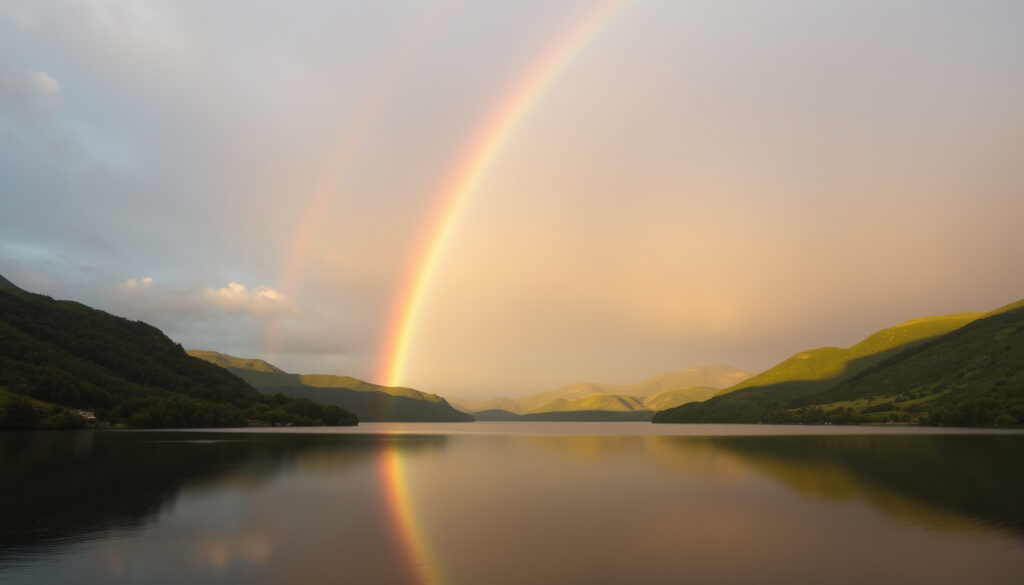
Arc-en-ciel Couleur – Seven Colors of the Rainbow
The seven colors of the rainbow form one of nature’s most recognizable patterns, appearing in a consistent sequence that has fascinated scientists and observers for centuries. From the brilliant red arc at the top to the subtle violet at the bottom, each hue corresponds to a specific wavelength of visible light. Understanding this spectrum requires examining both the scientific principles behind light refraction and the historical decisions that shaped how we categorize these colors today.
The rainbow’s color order remains fixed because of fundamental physics governing how light travels through water droplets. This predictable arrangement allows us to identify rainbows reliably and distinguish them from other atmospheric phenomena. The French term “arc-en-ciel” describes this same phenomenon, with “couleur” referring to the characteristic colors that define every rainbow’s appearance.
This guide examines the complete spectrum of rainbow colors, explaining why they appear in their specific order, how Isaac Newton’s experiments established our modern understanding, and what scientific principles govern their formation. Whether you are a student learning about optics or simply curious about the colors that follow rainfall, the information below provides comprehensive coverage of this timeless topic.
What Are the Colors of the Rainbow?
The rainbow displays seven distinct colors arranged in a specific spectrum. From outermost to innermost, these colors are red, orange, yellow, green, blue, indigo, and violet. This sequence has become so embedded in scientific and educational tradition that it forms the foundation for understanding visible light and the electromagnetic spectrum.
These seven colors represent the portion of the electromagnetic spectrum that human eyes can detect, spanning wavelengths from approximately 380 to 700 nanometers. Each color occupies a specific range within this spectrum, with red extending to the longest visible wavelengths and violet to the shortest.
- Rainbows always follow the same color order due to the physics of light refraction
- Isaac Newton established the seven-color model by matching it to musical notes
- The color sequence corresponds directly to wavelength frequency
- Red light bends least while violet bends most as light enters water droplets
- The term “arc-en-ciel couleur” refers to the standard spectrum in French
- Each color band contains millions of intermediate shades not typically distinguished
| English | French | Wavelength (nm) | Notes |
|---|---|---|---|
| Red | Rouge | 620-750 | Longest wavelength |
| Orange | Orange | 590-620 | |
| Yellow | Jaune | 570-590 | |
| Green | Vert | 495-570 | |
| Blue | Bleu | 450-495 | |
| Indigo | Indigo | 420-450 | Debated visibility |
| Violet | Violet | 380-420 | Shortest wavelength |
In What Order Do the Colors Appear in a Rainbow?
The colors of a rainbow always appear in the same sequence because of fundamental physics principles governing how light travels through different media. When sunlight enters a raindrop, it slows down and bends, a process called refraction. Different wavelengths of light bend at slightly different angles, causing white light to separate into its component colors.
Red appears at the outer edge of the arc because it has the longest wavelength among visible colors and bends the least during refraction. Violet appears at the inner edge because it has the shortest wavelength and bends the most. This separation creates the characteristic banded appearance that allows observers to identify individual colors within the continuum.
Understanding the ROYGBIV Mnemonic
The acronym ROYGBIV represents the seven colors in order: Red, Orange, Yellow, Green, Blue, Indigo, Violet. This mnemonic helps students and enthusiasts remember the sequence without needing to look it up each time. The acronym is pronounced “Roy G. Biv” as if it were a person’s name, making it memorable for educational purposes.
Several alternative mnemonics exist in English, including “Richard Of York Gave Battle In Vain,” which references the defeat of King Richard III at the Battle of Bosworth Field. In French contexts, the same color order applies, though the mnemonic differs to reflect the French language. The consistency of the sequence across languages demonstrates that the underlying physics remains constant regardless of how humans describe it.
French speakers refer to “rouge, orange, jaune, vert, bleu, indigo, violet” when describing the arc-en-ciel couleur sequence. This bilingual consistency proves useful for international scientific communication and cross-cultural education about optics.
Why Are There 7 Colors in a Rainbow?
The answer to why rainbows display seven colors involves both scientific principles and historical decisions made by Isaac Newton in the seventeenth century. Newton’s experiments with prisms demonstrated that white light contains all visible colors, but the specific number of discrete colors we identify remains somewhat arbitrary.
Newton originally identified only five colors in his initial experiments, but he later expanded this to seven to match the seven notes of the musical scale. This decision reflected Newton’s belief in mathematical harmonies underlying natural phenomena. He wrote in his work Opticks that he “divided the circle into seven equal parts” to align color theory with musical principles that were well-established in his era.
The actual physics involves continuous wavelengths rather than discrete bands. A rainbow contains millions of colors that blend smoothly from one to the next without clear boundaries. Scientists categorize these into seven colors for practical identification and educational purposes, but the spectrum itself contains infinitely more distinctions than the human eye readily perceives.
Rainbows form when sunlight enters spherical raindrops, refracts (bends), disperses into its spectral components, and reflects internally before exiting. This process creates the characteristic arc of colors visible after rainfall. The separation occurs because each wavelength of light has a unique refractive index when passing through water.
How Rainbows Form Through Light Refraction
The formation of a rainbow involves three optical phenomena occurring in sequence as light travels through a raindrop. First, light enters the spherical droplet and bends due to the change in medium from air to water. Second, the different wavelengths separate because each bends at a slightly different angle, a property called dispersion. Third, the separated light reflects off the back interior of the droplet and exits, bending again as it returns to air.
Red light, with its wavelength of approximately 700 nanometers, bends the least during this process and appears on the outer portion of the rainbow arc. Violet light, at roughly 380 to 400 nanometers, bends the most and appears on the inner portion. This relationship between wavelength and refraction angle explains why the color order never varies in primary rainbows.
The circular shape of rainbows results from the geometry of this process. Observers see only a semicircle because the ground blocks the lower half, but from aircraft or high vantage points, complete circular rainbows are visible. The center of the circle lies directly opposite the sun from the observer’s perspective.
The visible spectrum spans roughly 380 to 750 nanometers. Red wavelengths extend to about 750 nm while violet reaches down to approximately 380 nm. This range represents only a tiny fraction of the entire electromagnetic spectrum, which includes radio waves, microwaves, infrared, ultraviolet, X-rays, and gamma rays that human eyes cannot detect.
Is Indigo Really a Color in the Rainbow?
The inclusion of indigo in the rainbow spectrum remains one of the most debated aspects of the seven-color model. While Newton deliberately added indigo to create his seven-color system, many modern observers struggle to distinguish it from the surrounding blue and violet bands. This difficulty has led some scientists and educators to question whether indigo truly belongs in the spectrum.
Indigo represents a deep blue-purple color that falls approximately halfway between blue and violet on the visible spectrum. Its wavelength range spans roughly 420 to 450 nanometers. However, the human eye has limited ability to separate this narrow band from adjacent colors, particularly in the complex overlapping patterns that actual rainbows display.
Several modern representations omit indigo entirely, using only six colors. The LGBT pride flag, for example, displays red, orange, yellow, green, blue, and violet without including indigo. This simplification reflects both the practical difficulty of distinguishing indigo and a move toward more accessible color models that match how most people actually perceive rainbows.
Historical Context of the Seven-Color Model
Newton’s decision to include seven colors stemmed from philosophical and mathematical considerations rather than purely observational ones. Ancient thinkers like Aristotle had described rainbows using fewer categories, typically limiting themselves to three or four principal colors. Newton’s expansion to seven directly reflected his interest in aligning optics with music theory, where seven notes formed the basis of Western musical scales.
The historical record shows that Newton initially identified five colors in his 1672 paper “New Theory About Light and Colours.” He later expanded this to seven in his 1704 work Opticks, adding orange and indigo to match the musical scale. This expansion was controversial even among his contemporaries, with some scholars arguing that rainbows contained continuous color gradations rather than discrete bands.
Individual perception of rainbow colors varies significantly based on lighting conditions, the observer’s visual acuity, and atmospheric factors. Many people naturally see fewer than seven distinct bands, particularly in bright sunlight where colors blend more smoothly. This variability explains why some observers report seeing six colors while others insist on seven.
Can Rainbows Have More or Fewer Colors?
Technically, rainbows contain far more than seven colors—they display a continuous spectrum with millions of distinguishable hues. The bands we identify as “red” or “blue” actually contain thousands of subtle variations that blend smoothly into one another. Scientists can detect these variations using spectrometers, but the human eye typically groups them into broader categories.
Double rainbows offer an interesting variation on the standard spectrum. The secondary rainbow appears outside the primary arc and displays colors in reverse order, with red appearing on the inner edge and violet on the outer edge. This reversal results from light undergoing two internal reflections within raindrops rather than one. The secondary arc is typically fainter because additional reflections reduce light intensity.
Certain atmospheric conditions can produce rainbows with unusual color presentations. Red rainbows occasionally appear near sunset when atmospheric particles filter out shorter wavelengths before light reaches raindrops. Moonbows, created by moonlight rather than sunlight, typically appear much fainter and often show only white or pale colors due to the low light levels involved.
The Discovery of Rainbow Colors
The understanding of rainbow colors evolved significantly during the seventeenth century through careful experimentation and observation. Prior to this period, rainbows were often interpreted as omens or divine signs rather than natural phenomena with explainable causes.
- 1666 — Isaac Newton identifies seven colors using prism experiments, initially proposing five colors before expanding to seven
- 19th Century — The French term “arc-en-ciel” becomes standardized in optics texts across Europe
- Modern Era — Spectral analysis confirms the ROYGBIV sequence and provides precise wavelength measurements for each color band
Newton’s groundbreaking work built upon earlier observations by scholars like René Descartes, who had mathematically analyzed the rainbow’s geometry in 1637. However, Descartes believed that color resulted from different speeds of light in media, a theory that proved incomplete. Newton’s contribution was demonstrating that white light contains all colors already mixed together, with prisms and raindrops merely separating them based on wavelength. Per a més detalls sobre la direcció del sol, consulta On surt el sol.
The subsequent centuries have refined but not overturned Newton’s fundamental insights. Modern spectroscopy confirms the wavelength-based ordering of colors and has measured precise ranges for each band. Contemporary understanding emphasizes the continuous nature of the spectrum while acknowledging the practical value of the seven-color categorization for communication and education.
What’s Established and What’s Debated
Scientific consensus exists on several fundamental aspects of rainbow colors, while other aspects remain subjects of discussion and debate among educators and researchers.
| Established Facts | Debated or Uncertain Points |
|---|---|
| Primary rainbows always display seven colors | Indigo visibility varies significantly among observers |
| Red always appears on the outer edge | Some people perceive only six distinct colors |
| Color order follows wavelength physics | The pedagogical value of the seven-color model |
| Secondary rainbows reverse the color order | Whether ancient cultures perceived the same spectrum |
No major conflicts exist among scientific sources regarding the fundamental physics governing rainbow color order. All reliable sources agree that wavelength determines where each color appears in the spectrum. The debate centers more on pedagogical and perceptual questions—whether seven colors represents the optimal way to teach and discuss rainbows—rather than disputes over the underlying science.
The Physics Behind Color Separation
Understanding why rainbows display their characteristic colors requires examining how light behaves when transitioning between different media. When light enters water from air, it slows down and changes direction, with shorter wavelengths slowing more than longer ones. This differential bending creates the separation that produces the rainbow spectrum.
The index of refraction for water varies slightly depending on wavelength, a property called dispersion. Red light has a refractive index of approximately 1.331 at standard conditions, while violet light bends more strongly with an index around 1.343. This small difference accumulates as light travels through the droplet, resulting in the angular separation of several degrees between red and violet at the exit point.
Rainbow geometry depends on the angle between incoming sunlight and the observer’s line of sight. The brightest rainbow appears at approximately 42 degrees from the antisolar point—the location directly opposite the sun. Different colors emerge at slightly different angles within this band, creating the distinctive arc pattern that has inspired artists and scientists alike throughout history.
Environmental factors influence how clearly observers can distinguish individual colors. Large raindrops tend to produce rainbows with more distinct color bands, while small droplets create rainbows with more blended, pastel-like appearance. Fogbows, formed by cloud droplets rather than raindrops, often appear nearly white because the very small droplet sizes cause significant color overlap.
Historical Perspectives on Rainbow Colors
Throughout history, different cultures have categorized rainbow colors using varying numbers of bands. Ancient Greek philosophers like Aristotle typically described three or four principal colors, while many Asian traditions used five color categories aligned with elemental theories. The seven-color model that dominates modern Western science emerged specifically from Newton’s musical theory alignment.
Pre-Columbian cultures in the Americas developed their own interpretations of rainbow phenomena without access to European scientific methods. These traditions often integrated rainbows into mythological frameworks that explained their appearance through narrative rather than physical principles. Understanding these historical perspectives helps contextualize why our modern system seems natural to contemporary observers even though it represents one arbitrary choice among many possible alternatives.
Isaac Newton, Opticks (1704)
“I divided the circle into seven equal parts, corresponding to the seven notes of the musical scale, so that the colors might agree in number and order with those of the musical notes.”
Standard optics reference
“The colors of the rainbow are red, orange, yellow, green, blue, indigo, violet. In French, they are rouge, orange, jaune, vert, bleu, indigo, violet. This sequence, known as ROYGBIV, represents the standard order of colors from longest to shortest wavelength.”
Observing Rainbows Effectively
The seven colors of the rainbow appear most clearly under specific viewing conditions that maximize color separation and contrast. Standing with the sun behind you and rainfall ahead creates the optimal geometry for rainbow formation. The best displays typically occur when rain falls in a localized area while clearer skies exist in the sunward direction.
The size of raindrops significantly affects rainbow appearance. Larger droplets—around 1-2 millimeters in diameter—produce rainbows with vivid, well-separated colors. Smaller droplets create more diffuse, washed-out rainbows where individual colors blend together more noticeably. This relationship explains why summer thunderstorms often produce brighter rainbows than light drizzle.
Photography can reveal details invisible to casual observation. Camera sensors capture the full spectrum more uniformly than human eyes, often revealing color gradations that observers miss. High-speed photography of laboratory-created rainbows has documented the complex internal dynamics of light within droplets, showing how multiple reflections and refractions combine to produce the final visible arc.
For those interested in exploring rainbow phenomena further, experimenting with prisms provides direct experience with spectral separation. Simple glass prisms available from educational suppliers demonstrate the same principles that Newton studied centuries ago. These hands-on activities help solidify understanding of why colors appear in their fixed order regardless of viewing location or atmospheric conditions.
Double rainbows offer additional opportunities for observation, though they require specific conditions to become visible. The secondary arc appears approximately 9 degrees outside the primary rainbow and displays reversed color ordering. Its dimmer appearance results from additional light loss during the second internal reflection that creates it. For related atmospheric phenomena, Lake Effect Snow Squalls demonstrate how weather patterns create distinctive optical effects in different conditions.
Frequently Asked Questions
How is a rainbow formed?
Rainbows form when sunlight enters raindrops, refracts and disperses into its component wavelengths, reflects internally, and exits the droplet to reach the observer’s eye. The specific angle of refraction for each wavelength creates the characteristic arc with red on the outer edge and violet on the inner edge.
Can rainbows have more or fewer than seven colors?
Technically, rainbows contain millions of colors in a continuous spectrum. The seven-color model represents human categorization of this continuum. Some observers perceive only six distinct colors, particularly when indigo blends with blue or violet. The actual number depends on viewing conditions, droplet size, and individual perception.
Who discovered the colors of the rainbow?
Isaac Newton identified the seven-color spectrum through prism experiments in the 1660s and 1670s. He expanded his initial five-color model to seven colors to align with the seven notes in the musical scale. His work built upon earlier observations by scholars like Descartes but provided the first comprehensive scientific explanation of color separation in rainbows.
Why does the rainbow color order never change?
The fixed color order results from the physics of light refraction in water. Each wavelength has a specific refractive index, causing consistent angular separation. Red light bends least and appears on the outer edge; violet light bends most and appears on the inner edge. This relationship remains constant regardless of location, time, or atmospheric conditions.
What does ROYGBIV stand for?
ROYGBIV represents the seven colors of the rainbow in order: Red, Orange, Yellow, Green, Blue, Indigo, Violet. The acronym is pronounced “Roy G. Biv” and serves as a mnemonic to help remember the correct sequence from outermost to innermost color band.
Is indigo really necessary in the rainbow spectrum?
The necessity of indigo remains debated. Newton included it for symbolic reasons matching the musical scale, but many observers struggle to distinguish it from blue and violet. Some modern representations use six colors, omitting indigo. The choice reflects practical considerations about perception and education rather than strict physical requirements.
What are the French names for rainbow colors?
In French, the rainbow colors are rouge, orange, jaune, vert, bleu, indigo, and violet. The term “arc-en-ciel couleur” refers to this standard seven-color spectrum. The same order applies in French as in English because wavelength physics remains constant regardless of language.
Why do double rainbows appear?
Double rainbows occur when light reflects twice inside raindrops before exiting. This second reflection reverses the color order, placing red on the inner edge and violet on the outer edge. The secondary rainbow appears fainter because additional light loss occurs during the second reflection. Understanding these phenomena connects to broader weather patterns, much like how Can Dogs Have Blueberries relates to understanding natural variations in common substances.
More related posts
 Matt Smith: Relationships, Career & Controversies
 Jelly Roll: Wife, Fame, Tattoos, and Family Answered
 Toys R Us Canada: Status, Closures & CCAA Filing 2026
 Things to Do in New Brunswick: Top Attractions & Hidden Gems
 Dress Stores Near Me: Top Brands, Classic Styles & Local Guide
 The Man in the Moon (1991): Plot, True Story & Where to Watch
 Nail Salon Near Me: Pregnancy Safety, Age Limits, Tipping & Costs
 Pension Payments Dates December 2025: UK, Ireland & NZ