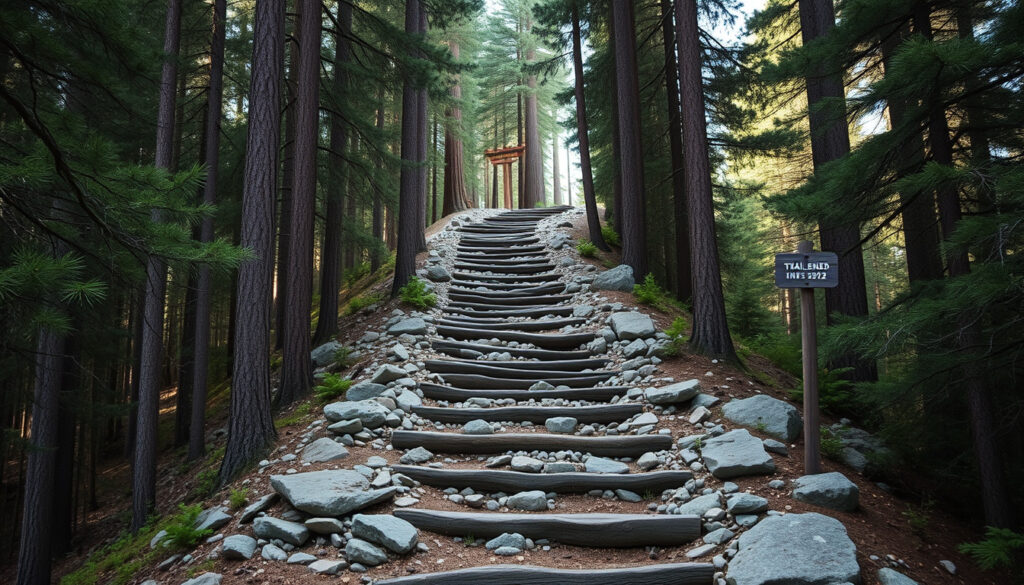
Grouse Grind: Difficulty, Time & Beginner Tips
There’s a reason hikers in Vancouver call the Grouse Grind “Mother Nature’s Stairmaster” — it’s a punishing 2.5 km climb that tests your legs, lungs, and willpower. This guide breaks down exactly what the Grind demands, how long it takes, whether beginners can tackle it, and what it does to your body.
Length: 2.5 km · Elevation Gain: 800 m · Average Time (Fit Hikers): 1–1.5 hours · Record Time: 25 minutes 1 second (Matt Shepard, 2010) · Difficulty Rating: Very steep, strenuous
Quick snapshot
- Length: 2.5 km (Grouse Mountain official operator FAQ)
- Elevation Gain: 800 m (Metro Vancouver regional parks authority)
- Start Elevation: 300 m (Metro Vancouver regional parks authority)
- Summit Elevation: 1,100 m (Metro Vancouver regional parks authority)
- Average fit hiker: 1–1.5 hours (Grouse Mountain official operator)
- Beginner: 1.5–2+ hours (Jenni Sheppard hiking guide)
- Record: 25 min 1 sec (Wikipedia)
- Strenuous, very steep (Metro Vancouver regional parks authority)
- Nicknamed “Mother Nature’s Stairmaster” (Grouse Mountain official operator)
- Not recommended for absolute beginners without preparation (Destination Vancouver tourism bureau)
- Burns 400–500 calories per hour (Verywell Fit fitness resource)
- Improves cardiovascular endurance (Verywell Fit fitness resource)
- Strengthens legs and core (Verywell Fit fitness resource)
- Aids weight loss and fat reduction (Verywell Fit fitness resource)
Seven key stats paint a clear picture of the Grouse Grind’s demands: location, length, elevation gain, typical times, the record, difficulty rating, and the window of operation.
| Specification | Value |
|---|---|
| Location | North Vancouver, British Columbia, Canada |
| Length | 2.5 km (1.6 miles) |
| Elevation Gain | 800 m (2,625 ft) |
| Average Time | 1–1.5 hours (fit hikers) |
| Record Time | 25 minutes 1 second (Matt Shepard, 2010) |
| Difficulty | Very steep, strenuous |
| Season | Open year-round, weather permitting; busiest summer/fall |
Is the Grouse Grind difficult?
What is the difficulty rating of the Grouse Grind?
- Metro Vancouver officially labels the trail “very steep” and notes the 800 m climb over just 2.5 km — an average gradient of about 32% (Metro Vancouver regional parks authority).
- Grouse Mountain calls it “Mother Nature’s Stairmaster” and warns that downhill travel is banned because the trail is too narrow and dangerous (Grouse Mountain official operator FAQ).
- AllTrails data suggests a distance of 2.9 km with 853 m gain, but the official figures from Metro Vancouver remain the standard (AllTrails hiking community platform).
How does the Grouse Grind compare to other hikes?
By urban hike standards, the Grind is punishing. The nearby BCMC Trail also climbs to Grouse Mountain but is slightly longer and less steep. Outdoor Vancouver estimates the Grind takes about 1.5 hours for a moderate hiker, whereas the BCMC usually runs 1.5–2 hours (Outdoor Vancouver local outdoor guide). Across Canada, few city-accessible trails pack 800 m of vertical into such a short distance.
The Grouse Grind is not a casual stroll; it’s a vertical fitness test. Most casual day-hikers will find it the hardest short trail they’ve ever done.
Bottom line: The Grind is objectively very hard — it’s 800 m of climbing in 2.5 km. Weekend warriors should budget 1.5 hours and expect to stop. Only experienced hikers with strong cardio should aim for sub-1-hour times.
How long does it take to do the Grouse Grind?
Is 1 hour for the Grouse Grind good?
- A 1-hour finish is considered very good — it puts you well above average. Grouse Mountain says the typical fit hiker takes 1–1.5 hours (Grouse Mountain official operator).
- AllTrails user data shows an average completion time of 1 hour 42 minutes (AllTrails hiking community platform).
What is the average time for a fit hiker?
Frequent participants clock in between 45 and 90 minutes. The Grind is often used as a timed workout by locals; many chase personal records. The Grouse Grind Mountain Run is an annual event, though no new record has beaten Matt Shepard’s 2010 mark of 25 minutes 1 second (Wikipedia).
What is the fastest recorded time?
The standing record is 25 minutes and 1 second, set by professional runner Matt Shepard in 2010 during the Grouse Grind Mountain Run. That’s an average pace of 10 minutes per km — on a trail that gains over 300 m per km. No one has beaten it in over a decade (Wikipedia).
Your time on the Grind is a direct measure of your climbing fitness. Sub-1 hour puts you in the top tier of recreational hikers; over 2 hours still gets you to the top, but preparation matters more.
Can a beginner do the Grouse Grind?
What should beginners know before attempting the Grouse Grind?
- Destination Vancouver advises pacing yourself because it’s easy to overdo it if you start too fast (Destination Vancouver tourism bureau).
- Jenni Sheppard, a Vancouver-based hiker, recommends carrying at least 1 litre of water, wearing sturdy shoes, and taking breaks at the benches along the trail (Jenni Sheppard hiking guide).
- The trail is closed November to May, at night, and during hazardous weather (Destination Vancouver tourism bureau).
How long does it take a beginner to do the Grouse Grind?
Beginners typically take 1.5 to 2 hours or more, depending on fitness and comfort level. AllTrails reports the overall average (including beginners) is 1 hour 42 minutes (AllTrails hiking community platform). A first-timer with moderate fitness should expect to stop several times. The trail is not recommended for people with heart conditions or severe asthma without clearance from a doctor.
Beginners can do the Grind — but the price is discomfort, longer time, and muscle soreness. If you’re unfit, your body will rebel. Proper hydration, pacing, and a pre-hike carb snack are essential.
Why is it called Grouse Grind?
What does “Grind” refer to?
- The word “Grind” perfectly describes the repetitive, relentless uphill motion — it’s not a walk, it’s a slog. The name became common in the 1970s when hikers started using the route informally (Wikipedia).
Is there a connection to grouse birds?
Yes. The trail is named after the Blue Grouse (now called Sooty Grouse) that were once hunted in the area. “Grouse” in the name references the bird; “Grind” references the effort. Together they create a fitting label for a climb that demands grit (Wikipedia).
Bottom line: The name is honest: “Grouse” for the local bird, “Grind” for the workout. Anyone who hikes it quickly understands why the word “Grind” stuck.
What happens to your body after hiking?
Can you lose belly fat by hiking?
- Verywell Fit estimates that a 70 kg person burns roughly 400–500 calories per hour on a steep, continuous ascent like the Grind (Verywell Fit fitness resource). Over several months of regular hiking (3–4 times per week), that calorie deficit can reduce overall body fat, including visceral fat around the belly — provided diet is also controlled.
Is hiking good for weight loss?
Yes. A single round of the Grind burns roughly the same calories as a 45-minute run, but with less impact on joints. Combined with a protein-rich diet, regular hiking builds lean muscle in the legs, glutes, and core, which raises resting metabolism. A study by the American Council on Exercise found that hiking on steep terrain can increase calorie burn by 40–50% compared to flat walking.
What are the long-term health benefits of regular hiking?
- Improved cardiovascular fitness and lower resting heart rate
- Strengthened leg muscles, especially quadriceps and calves
- Better bone density due to weight-bearing exercise
- Reduced risk of type 2 diabetes and hypertension
- Consistent hiking also releases endorphins, reducing stress and anxiety
The Grouse Grind is so hard that many people avoid it — but that same difficulty makes it one of the most efficient workouts in Vancouver. A single climb delivers cardiovascular, strength, and calorie-burning benefits that flat hiking can’t match.
btr.michaelkwan.com, reddit.com, cowleyvisuals.com, youtube.com
If you’re planning to tackle the Grouse Grind, you might also appreciate a complete guide to Grouse Mountain for its hiking and skiing options.
Frequently asked questions
Do I need a pass or ticket to hike the Grouse Grind?
No, the trail itself is free. However, if you want to take the Skyride gondola down — which many hikers do — a one-way download ticket costs $20 for adults and $10 for children ages 5-12 when purchased online (Grouse Mountain official operator FAQ).
Is the Grouse Grind free?
Yes, there is no fee to climb the Grouse Grind trail. Only the gondola ride down has a cost (Grouse Mountain official operator FAQ).
What is the best time of day to start the Grouse Grind?
Summer hours typically run from 7:00 am to 7:00 pm. Starting early (7–9 am) helps beat the heat and crowds. Afternoon starts risk running into traffic on the trail and possible closure if thunderstorms roll in (Grouse Mountain official operator FAQ).
Should I bring hiking poles?
Many hikers use them on the descent, but downhill is not permitted on the Grind. On the ascent, poles can help distribute effort to your arms, but they’re not necessary for most fit hikers (Destination Vancouver tourism bureau).
Is there a shuttle or public transit to the trailhead?
Yes, TransLink bus route 236 from Lonsdale Quay drops you off at the Grouse Mountain base. Parking at the base lot is free but fills up quickly on weekends (Destination Vancouver tourism bureau).
What is the BCMC trail and how does it differ from the Grouse Grind?
The BCMC (British Columbia Mountaineering Club) trail runs parallel to the Grind, starting from the same base but taking a slightly longer, less steep route. It’s about 3 km long and gains roughly the same elevation. Many hikers use the BCMC as a quieter alternative when the Grind is crowded (Outdoor Vancouver local outdoor guide).
How do I get to the Grouse Grind trailhead from downtown Vancouver?
Take the SeaBus from Waterfront Station to Lonsdale Quay. From there, board bus 236 towards Grouse Mountain. The ride takes about 30 minutes total. If driving, take Highway 1 to Capilano Road and follow signs to Grouse Mountain — the base lot is free but often full by 9 am on summer weekends (Destination Vancouver tourism bureau).
Related reading
- Mount Denali: Height, Naming History & Climbing Facts
- Poison Ivy: Identification, Rash Treatment, and Myths Debunked
For anyone living in Vancouver, the choice is clear: either you commit to the Grind as a regular fitness routine — maybe twice a week — or you miss out on one of the city’s most effective and natural workouts. The Grind doesn’t get easier, but you get stronger, and that’s the whole point.
More related posts
 Toys R Us Canada: Status, Closures & CCAA Filing 2026
 Jacob Lofland: Biography, Age, Height, and Relationship
 That’s So True Lyrics: Gracie Abrams Full Song & Meaning
 New Serie to Watch in 2026: Top Trending Show on Netflix, Prime
 Slow Horses Season 5: Release Date, Episodes & Reviews
 Arc-en-ciel Couleur – Seven Colors of the Rainbow
 Olympic Hockey Scores Today: USA Gold vs Canada OT
 Canadian Tariffs on US Goods: 2025 Rates and Trade War Update