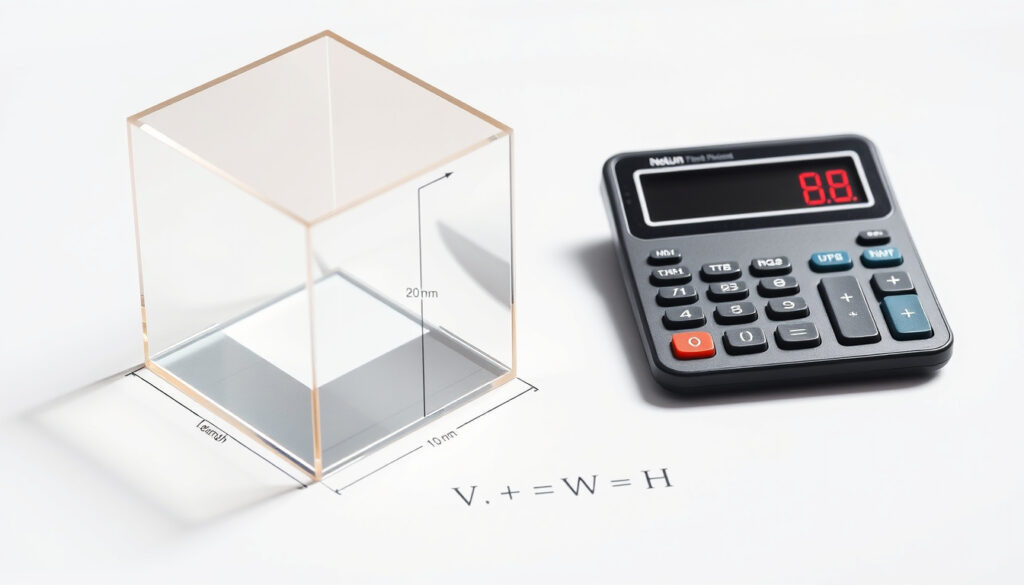
Volume of Rectangular Prism: Formula, Calculator & Examples
Whether you’re packing up for a move, measuring ingredients for a concrete pour, or helping a fifth-grader with homework, you’ll eventually need to find how much space a box-shaped object holds. The good news: the math behind this is about as straightforward as it gets. You multiply three numbers together. That’s it. This guide walks through the exact formula, why it works, and how to apply it to everything from a shoebox to a shipping container.
Standard Formula: V = l × w × h · Alternative: Base area × height · Units: Cubic units (e.g., cm³, m³)
Quick snapshot
- The formula V = l × w × h appears consistently across Khan Academy, Cuemath, and Omni Calculator
- A rectangular prism has 6 faces, 12 edges, and 8 vertices (Khan Academy)
- Doubling all dimensions multiplies volume by 8 (Khan Academy)
- Some diagonal-based volume formulas found online lack independent peer review
- Engineering-specific variations (e.g., tapered prisms) fall outside standard classroom coverage
- The V = lwh formula has been standard in geometry curricula since at least the early 20th century (Omni Calculator)
- Digital tools like Omni Calculator have recently added diagonal-based variations
- Online volume calculators now handle fractional inputs directly
- Worksheet generators make practice problems widely available for classroom and self-study use
Four key data points emerge across educational resources: the formula itself, the structural makeup of a rectangular prism, the effect of scaling dimensions, and the practical tools available for calculation.
This reference table consolidates the core formula details and educational resources.
| Label | Value |
|---|---|
| Formula | V = l × w × h |
| Alternative | Base area × height |
| Source Confirmation | Khan Academy, Cuemath |
| Calculator Tool | Omni Calculator available |
| Structural facts | 6 faces, 12 edges, 8 vertices |
| Grade level | Introduced in 5th grade |
What is the formula for volume of rectangular prisms?
Base area calculation
The foundation of the formula lies in understanding what you’re actually measuring. A rectangular prism is a three-dimensional shape with six flat rectangular faces—think of a standard cardboard box. Each of those faces is itself a rectangle, which means you can calculate its area using length times width. The base of the prism is simply one of those rectangles, and its area equals length multiplied by width (Khan Academy confirms this relationship).
To find the base area, you identify two perpendicular dimensions that form one face of the prism. If you label those dimensions as length (l) and width (w), then base area B equals l × w. This calculation works for any face you choose as your base, but the principle remains the same: you’re finding the area of a two-dimensional rectangle first.
Full volume equation
Once you have the base area, the volume follows by extending that two-dimensional foundation into the third dimension. You multiply the base area by the height (h) of the prism, which gives you the complete formula V = (l × w) × h (Cuemath explains this as the base-area-then-height approach). The parentheses are optional because multiplication is associative, so you can write this equivalently as V = l × w × h.
The formula works because you’re stacking layers of the base area up to the height of the prism. Each layer has the same area, and the number of layers equals the height. That’s why volume ends up in cubic units—it’s a measure of how many unit cubes fit inside.
The relationship between base area and total volume gives students a concrete way to visualize what cubic units represent: you’re essentially counting how many unit-thick layers fit within the height dimension.
How to calculate volume of rectangular prisms?
Measure dimensions
Before you calculate anything, you need accurate measurements. The three dimensions you need are length, width, and height—always measured perpendicular to each other. For a simple box, this usually means measuring the longest edge (length), the shorter edge at right angles (width), and the vertical dimension (height). IXL’s lesson on volume of rectangular prisms emphasizes that the key is identifying which edge corresponds to which dimension, not any specific naming convention.
Make sure all three measurements use the same unit. If your length is in centimeters, your width and height must also be in centimeters. Mixing units (like using inches for length and centimeters for width) produces an incorrect result. Omni Calculator notes that using consistent units is non-negotiable for accurate volume calculations.
Multiply length width height
With clean measurements in hand, the calculation becomes straightforward: multiply the three numbers together. Using the example from Omni Calculator, a container with dimensions of 12 inches by 10 inches by 8 inches gives a volume calculation of 12 × 10 × 8, which equals 960 cubic inches.
You don’t need to follow a specific order. Because multiplication is commutative, l × w × h produces the same result as w × l × h or any other arrangement. The Maths Guy demonstrates on YouTube that this flexibility means students can multiply in whatever order feels natural to them.
Understanding that order doesn’t matter reduces cognitive load. Students who feel intimidated by math often freeze up trying to remember the “right way” to start a problem. The commutative property gives them permission to begin with whichever dimensions they can most easily multiply.
This freedom to choose multiplication order empowers students to approach problems with confidence rather than anxiety.
What is the formula for L * W * H?
Dimensions defined
The expression L × W × H is simply shorthand notation for the same volume formula, using capital letters to represent the three dimensions: Length, Width, and Height. Cuemath defines these dimensions as the three mutually perpendicular edges that define the size of a rectangular prism. No matter which convention you use (l, w, h or L, W, H), the meaning is identical.
In some educational contexts, L represents the longest dimension, W the medium, and H the shortest—or the three can be assigned more or less arbitrarily. The critical point is that you’re identifying three perpendicular edges and multiplying them together, regardless of the letter labels assigned.
Application to prisms
For any rectangular prism—whether it’s a textbook, a filing cabinet, or a swimming pool—the volume equals the product of these three edges. Khan Academy’s review of volume of rectangular prisms demonstrates this principle with multiple worked examples, from simple integer dimensions to more complex scenarios.
One practical consideration: when working with fractional dimensions, the formula still applies exactly. Study.com’s lesson on finding volume with fractional edge lengths walks through an example with l = 7/9, w = 1/6, and h = 1/5, showing that you can calculate the base area first (multiplying the fractions) then multiply by the height.
This consistency across integer, fraction, and decimal inputs is what makes the formula universally applicable in mathematics education.
How to find the volume of the prism?
General prism vs rectangular
It’s worth distinguishing between different types of prisms. A general prism has two identical parallel bases and rectangular lateral faces. The volume formula for any prism is V = base area × height (the perpendicular distance between the bases). Cuemath confirms that this principle applies to both right prisms (where lateral faces are perpendicular to the bases) and oblique prisms (where lateral faces lean).
The key refinement for a rectangular prism is that the base is specifically a rectangle, meaning its area is simply length times width. For triangular prisms, you’d calculate the triangle’s area as the base area first. For cylinders, you’d use the circle area formula. But rectangular prisms have the simplest base-area calculation.
Rectangular specifics
For rectangular prisms specifically, the general prism formula simplifies to V = (l × w) × h, which collapses to V = l × w × h. Math with Mr. J’s YouTube tutorial demonstrates this calculation step-by-step, starting with identifying dimensions in a word problem and ending with the final volume in cubic units.
The rectangular prism is also called a cuboid. Cuemath notes that a cuboid is essentially a rectangular box of any proportions—including cubes where all three dimensions are equal. The volume formula works identically for cubes; you simply have the special case where l = w = h.
This synonym coverage ensures students recognize both terms in different textbooks and resources.
What are the two formulas for a rectangular prism?
V = lwh
The first formula is the direct three-dimensional multiplication V = l × w × h. This approach treats all three dimensions equally, multiplying them together in a single step. The Khan Academy review of volume of rectangular prisms presents this as the primary formula, and it’s the version most commonly taught in elementary and middle school mathematics.
This formula works because multiplication of three dimensions effectively counts how many unit cubes fit inside the prism. If you have a 2-unit by 5-unit by 7-unit rectangular prism, you can picture 2 unit cubes in one direction, 5 in another, and 7 in the third, with the total being 2 × 5 × 7 = 70 unit cubes inside.
V = base area × height
The second formula breaks the calculation into two stages: first find the base area (B = l × w), then multiply by the height (V = B × h). Cuemath presents this as an equivalent alternative, noting that it often helps students understand why volume is measured in cubic units. Study.com reinforces this two-step approach in their lesson on fractional edge lengths.
Using the base-area method, the same container example from earlier (12 in × 10 in × 8 in) would first calculate the base area as 12 × 10 = 120 square inches, then multiply by the height to get 120 × 8 = 960 cubic inches. The answer matches because these two formulas are mathematically identical.
These aren’t actually two different formulas—they’re the same formula written differently. Some online sources claim there are “two formulas” to suggest there’s variation or choice, but any reputable mathematics source confirms they’re equivalent expressions of the same relationship.
The implication for learners is that the choice between approaches depends on personal preference or problem context, not on correctness.
Step-by-step calculation
Working through a volume calculation methodically helps build intuition. Here’s how to apply the formula in practice.
- Identify your three dimensions. Locate the length (l), width (w), and height (h) of your rectangular prism. Label them clearly so you don’t lose track during calculation.
- Confirm consistent units. Verify that all three measurements use the same unit of length. If they don’t, convert one or more before proceeding. Mixing units produces meaningless cubic results.
- Calculate the base area (optional step). Multiply length by width to find the base area: B = l × w. This intermediate step helps some people visualize what they’re computing.
- Multiply by height. Take either the base area from step 3 (B × h) or directly multiply all three dimensions (l × w × h). Either approach yields the same answer.
- Express your answer in cubic units. Write your result with the cubed unit indicator: cm³, m³, in³, ft³, or whatever matches your original measurements. Without the cubic notation, you’re reporting an area, not a volume.
What affects volume besides dimensions?
Scale effects
Changing dimensions has predictable effects on volume. According to Cuemath, if you double all three dimensions, the volume increases by a factor of 2³ = 8. If you double only the length while keeping width and height constant, the volume doubles. If you double the length and halve the height (keeping width constant), the volume stays the same because the increase and decrease cancel out.
These scale relationships matter in practical scenarios. When engineers design shipping containers, they need to understand how changes in dimensions affect the cost of material (driven by surface area) versus the capacity (driven by volume). When architects plan rooms, they calculate volume to determine heating and cooling requirements.
The pattern reveals that volume scales with the cube of any linear dimension change, which architects and engineers exploit when optimizing designs for cost and efficiency.
Composite shapes
Real-world objects rarely consist of a single rectangular prism. A storage shed might combine a rectangular main section with a smaller rectangular attachment. A piece of furniture might have indentations that create composite shapes. For these situations, you calculate each section’s volume separately, then add them together.
A YouTube tutorial on composite rectangular prisms demonstrates this approach with an example where three separate rectangular sections yield volumes of 840, 400, and 128 cubic units, totaling 1368 cubic units. The principle is simple: divide complex shapes into simpler ones, calculate each piece, then sum the results.
This decomposition strategy extends the basic formula to virtually any box-shaped object, no matter how irregular.
Confirmed facts and open questions
Confirmed facts
- The formula V = l × w × h appears identically across Khan Academy, Cuemath, Omni Calculator, IXL, and Study.com
- A rectangular prism has exactly 6 rectangular faces, 12 edges, and 8 vertices
- The formula applies to both right prisms and oblique prisms, using perpendicular height
- Doubling all three dimensions multiplies volume by 8 (2³)
- Multiplication order does not affect the result due to commutativity
Open questions
- Some advanced diagonal-based volume formulas found in online calculators have not been independently verified in peer-reviewed sources
- Engineering-specific applications (tapered prisms, composite materials) fall outside standard curriculum coverage
- Regional curriculum variations in when the formula is introduced have not been systematically documented
The confirmed facts represent consensus across authoritative educational sources, while open questions highlight areas where additional research or documentation would strengthen the knowledge base.
Expert perspectives
Khan Academy (educational platform) states that “the formula for finding the volume of a rectangular prism is V = l × w × h” and that students should practice identifying dimensions from word problems before attempting calculations.
Omni Calculator (math tool publisher) confirms the standard formula and additionally provides a diagonal-based alternative for cases where face diagonals are known instead of direct edge measurements.
Cuemath (educational site) emphasizes that volume measures “the space inside the prism” and presents both the direct three-multiplication method and the two-step base-area-then-height approach as equivalent strategies.
Calculator Soup (geometry reference) provides related formulas including surface area (S = 2(lw + lh + wh)) and space diagonal (d = √(l² + w² + h²)) for contexts where these additional calculations are needed.
These expert sources collectively reinforce the standard formula while providing supplementary approaches and related calculations for specialized needs.
Related reading: Cm to Ft and Inches Conversion · Inch to CM Conversion
While the volume formula V = l × w × h suits shoeboxes and rooms perfectly, the surface area of a cuboid becomes crucial for wrapping, painting, or manufacturing these everyday shapes.
Frequently asked questions
What units are used for volume of rectangular prism?
Volume is expressed in cubic units: cm³ (cubic centimeters), m³ (cubic meters), in³ (cubic inches), or ft³ (cubic feet). The unit depends on what you measured your dimensions in. If you measured in centimeters, your volume is in cubic centimeters. Always include the cubed notation to indicate volume rather than area.
How does volume of rectangular prism differ from pyramid?
A pyramid has a pointed top that reduces volume compared to a prism of the same base. The volume formula for a pyramid is V = (base area × height) ÷ 3. For the same base dimensions and height, a rectangular pyramid holds exactly one-third the volume of the corresponding rectangular prism.
Can volume be calculated with square base?
Yes. A square base is simply a special case where length equals width. For a square base with side s and height h, the volume formula becomes V = s × s × h, or V = s² × h. The same principle applies whether the base is square or rectangular.
What if dimensions are in different units?
You must convert all dimensions to the same unit before multiplying. To convert centimeters to inches, multiply by 0.3937. To convert inches to centimeters, multiply by 2.54. Once all three dimensions are in matching units, apply the formula normally and express the result in cubic units of that same measurement.
Is there a volume formula for oblique prisms?
An oblique prism has slanted sides but flat rectangular top and bottom faces. The volume formula is the same: V = base area × height. However, for oblique prisms, you must use the perpendicular height—the vertical distance between the two bases—rather than the slanted edge length.
How to use volume of rectangular prism worksheet?
A worksheet typically provides dimensions for several rectangular prisms. Work through each one by identifying the length, width, and height values, multiplying them together, and recording the result with appropriate cubic units. Good worksheets include word problems that require extracting dimensions from a narrative description.
Volume of rectangular prism in litres example?
One litre equals 1,000 cubic centimeters (cm³). For a box measuring 20 cm × 10 cm × 5 cm, the volume is 20 × 10 × 5 = 1,000 cm³, which equals exactly 1 litre. To convert larger volumes to litres, divide the cubic centimeter result by 1,000.
Key takeaways
The volume formula for a rectangular prism is remarkably simple: multiply three dimensions together. The formula V = l × w × h is universal across mathematics education worldwide, appearing identically in Khan Academy’s curriculum, Cuemath’s lessons, and virtually every other educational resource. Two equivalent forms exist—the direct multiplication and the two-step base-area-then-height approach—but they’re mathematically identical.
For students learning this concept, the practical value extends far beyond the classroom. Whether you’re calculating how much paint to buy for a rectangular room, how many boxes fit in a moving truck, or how much concrete to order for a slab foundation, the same three-step process applies: measure, multiply, and convert units as needed.
For teachers and parents helping students with homework, the key insight is that the formula’s simplicity is also its power. The commutative property means students can multiply in any order. The two-step method means those who struggle with three-number multiplication can break it into two easier calculations. And the universal nature of the formula means every problem is solvable using the same approach.
More related posts
 New Serie to Watch in 2026: Top Trending Show on Netflix, Prime
 Ralph Lauren Ireland: Stores, Outlets & Pronunciation
 Princess Anne: Biography, Health, Family, and Royal Role
 Air Canada Suitcase Mixup: Claims, Compensation & Fixes
 Slow Horses Season 5: Release Date, Episodes & Reviews
 Jean-Claude Van Damme: Biography, Health, Feuds, and Movies
 Law & Order: Organized Crime Cast – Full Season 5 Guide
 Corned Beef and Cabbage: Be t Method, Mi take & Diabete Tip