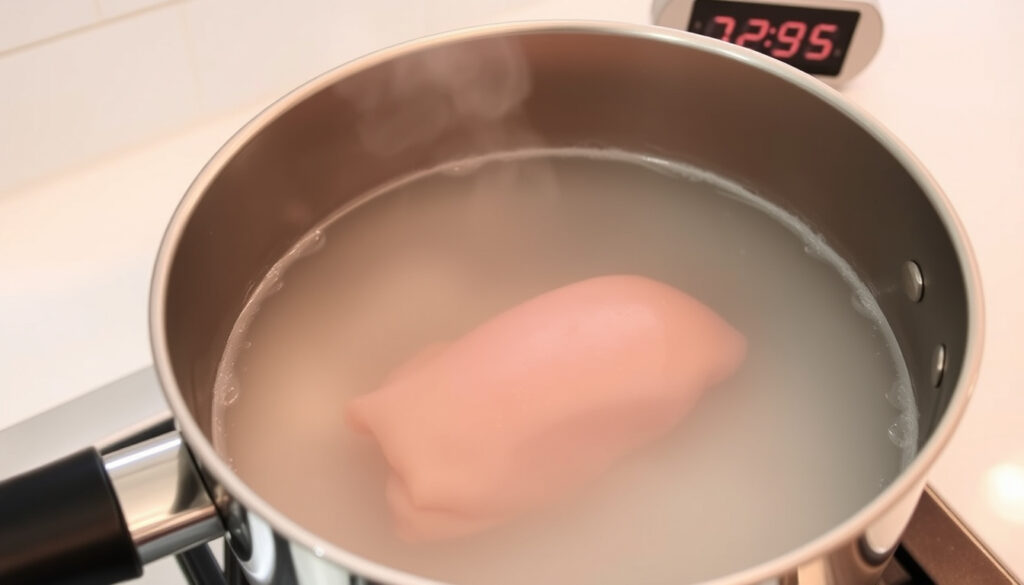
How Long to Boil Chicken Breast: Perfect Timing Every Time
There’s a reason so many home cooks swear by boiled chicken: it’s simple, reliable, and endlessly versatile. But the difference between tender, juicy meat and dry, stringy shreds comes down to one thing: timing — here’s the science-backed guide to nailing it every time with no guesswork required.
Boiling time (boneless, skinless): 12–15 minutes ·
Boiling time (bone-in): 18–20 minutes ·
Safe internal temperature: 165°F (74°C) ·
Water level: Cover chicken by 1 inch ·
Resting time before shredding: 5 minutes
Quick snapshot
- Chicken must reach 165°F to be safe (My Forking Life food blog)
- Boiling time increases with thickness and bone-in (Delish food magazine)
- Overcooking leads to dry, stringy texture (Wisconsin River Meats butcher)
- Cold water start produces more tender meat (Delish food magazine)
- Whether covering the pot significantly shortens cooking time
- Exact effect of adding vinegar or lemon to water on tenderness
- Ideal water-to-chicken ratio for maximum moisture retention
- 0–5 min: Bring water to a gentle simmer
- 5–20 min: Simmer until internal temp reaches 165°F
- 5 min rest: Let chicken sit before slicing or shredding
- Rest 5 minutes, then shred or slice
- Reserve cooking liquid as broth
- Store in fridge up to 4 days or freeze 3 months
Five key facts at a glance—from timing to safety—are summarized in the table below.
| Fact | Detail |
|---|---|
| Boiling time range | 10–20 minutes depending on size and bone-in |
| Safe internal temperature | 165°F (74°C) |
| Water level | Cover chicken by 1 inch (2.5 cm) |
| Boneless vs bone-in | Boneless 12–15 min, bone-in 18–20 min |
| Best thermometer type | Instant-read digital thermometer |
How long should you boil chicken breasts for?
Boiling time for boneless skinless chicken breast
- Most boneless, skinless chicken breasts (around 6–8 oz each) need 12–15 minutes at a gentle simmer after the water comes to a boil, per My Forking Life food blog.
- Thinner cutlets may be done in as little as 8–10 minutes, notes Delish food magazine.
- The safest way: pull the chicken when the thickest part hits 165°F (74°C) on an instant-read thermometer.
Boiling time for bone-in chicken breast
- Bone-in breasts take longer—typically 18–20 minutes of simmering, according to Wisconsin River Meats butcher.
- The bone conducts heat differently, so always verify with a thermometer inserted near the bone without touching it.
Boiling time for chicken breast halves
- Halves (cut lengthwise) cook faster because they’re thinner. Expect 8–12 minutes simmer time. He and She Eat Clean healthy cooking blog suggests checking at 8 minutes for smaller halves.
Boiling time for shredded chicken
- If you’re boiling specifically for shredding, aim for the upper end of the timing range so the meat is tender enough to pull apart easily. Let it rest 5 minutes, then use two forks or a mixer.
- Maple Jubilee recipe site recommends simmering boneless breasts for up to 1 hour for very tender shredded meat—though the USDA safe temperature still applies.
Boiling time for dog food
- For plain boiled chicken to feed your dog, cook boneless, skinless breasts to 165°F. 15–18 minutes at a simmer is usually enough. No salt, no seasoning. Let cool completely before serving.
Boiling time for soup
- When adding raw chicken to soup, simmer until the internal temp hits 165°F. Boneless breasts take about 15–20 minutes in a simmering broth. Bone-in will need 25–30 minutes.
The pattern is clear: thickness and bone structure dictate timing. The implication is that a single time recommendation cannot replace spot-checking with a thermometer.
Do I put chicken in water before or after it boils?
Starting chicken in cold water vs boiling water
- Cold start wins for tenderness. Delish food magazine explains that placing chicken in cold water and bringing it to a simmer allows the meat to cook more evenly, resulting in a juicier texture.
- Dropping raw chicken into already-boiling water shocks the exterior, causing it to seize up while the inside remains undercooked. This leads to uneven doneness and toughness.
Effect on texture and moisture
- A gentle transition from cold to hot helps the proteins relax gradually, retaining moisture. Wisconsin River Meats butcher confirms that a simmer (not a boil) is key to keeping the meat supple.
- The trade-off: a cold start takes a few minutes longer to bring up to temperature, but the texture payoff is worth it.
Home cooks who drop chicken into boiling water are setting themselves up for dry meat. Starting cold and simmering gently is the single best change you can make for juicier results.
The catch: the few extra minutes a cold start requires are a small price for meat that stays moist through the center.
How to tell if chicken breast is fully boiled?
Using an instant-read thermometer
- The only reliable method: insert an instant-read thermometer into the thickest part of the breast. The reading must be 165°F (74°C)—this is the USDA Food Safety and Inspection Service guideline.
- Check in multiple spots, especially near the bone for bone-in pieces.
Visual and tactile cues
- Juices run clear. Pierce the thickest part; if the liquid that comes out is clear (not pink), the chicken is likely done.
- No pink color. Cut into the center—the meat should be white throughout, with no translucent or pink areas.
- Firmness. The meat should feel springy when pressed, not soft or rubbery. Overcooked chicken feels hard and resists when pressed.
What this means: even experienced cooks get fooled by appearance. A thermometer removes the guesswork entirely.
What are common mistakes when boiling chicken?
Boiling at a full rolling boil
- A vigorous boil shreds the proteins and pushes moisture out. Delish food magazine warns: “Do not boil the entire time—reduce to a simmer immediately.”
Overcrowding the pot
- If chicken pieces are stacked, the water temperature drops and cooking becomes uneven. Use a pot large enough for a single layer.
Not salting the water
- Maple Jubilee recipe site recommends adding 1 tablespoon of salt per pot—it seasons the meat and helps it retain moisture.
Skipping the thermometer
- Relying solely on a timer risks either undercooking (unsafe) or overcooking (dry). Confessions of a Baking Queen recipe blog stresses using an instant-read thermometer in multiple spots.
Overcooking or undercooking
- Even at a simmer, chicken left too long—beyond 30 minutes—will dry out. Undercooked chicken (<145°F) poses a salmonella risk. The narrow window of perfection is why a thermometer is non-negotiable.
Most of these mistakes are easy fixes, but together they create the difference between a successful batch of chicken and a disappointing one. The simplest upgrade: invest in a $10 digital thermometer.
The implication: correcting these five mistakes turns boiled chicken from a gamble into a reliable, repeatable technique.
Can you overcook chicken by boiling it?
Signs of overcooked boiled chicken
- Yes, you can overcook chicken even in water. Prolonged heat causes proteins to tighten and expel moisture, leaving the meat dry and stringy. Wisconsin River Meats butcher notes that overboiled chicken becomes tough and unappealing.
- Signs: the meat pulls apart into fibers without any juiciness, and it feels rubbery or hard when bitten.
How to avoid overcooking
- Use a timer and check temperature early. Remove the chicken as soon as the internal temp hits 165°F—every minute beyond that accelerates moisture loss.
- If you’re cooking for shredding and want very tender meat, you can simmer up to an hour, but the texture becomes more like pulled chicken—still usable for soups and tacos.
Rescuing overcooked chicken
- If you’ve gone too far, shred the meat and add it to a sauce or broth where liquid can rehydrate it. It won’t be as juicy, but it works for enchiladas, casseroles, or chicken salad.
Overcooking is the number one reason people think boiled chicken is dry. With a thermometer and a simmer-not-boil strategy, that reputation becomes a myth.
The pattern: even overcooked chicken has a second life in saucy dishes. The real loss is texture, not usability.
Step-by-step: How to boil chicken breast perfectly
- Prep the chicken. Trim any excess fat or skin. If using skinless, it’s ready. Season both sides with salt (optional).
- Choose a pot. Use a pot large enough to hold the chicken in a single layer. A 3.5-quart pot works for 2–3 breasts.
- Add liquid. Place the chicken in the pot and add cold water (or broth) until the chicken is covered by 1 inch (2.5 cm). Add 1 tablespoon salt if desired.
- Bring to a simmer. Heat over medium-high until small bubbles appear—do not let it reach a rolling boil. Once simmering, reduce heat to maintain a gentle simmer.
- Cover and cook. Cover the pot with the lid slightly cracked to allow steam to escape, as recommended by Maple Jubilee recipe site. Simmer for the appropriate time based on cut (see timing table).
- Check temperature. After the minimum time, insert an instant-read thermometer into the thickest part. Target: 165°F (74°C).
- Rest. Once done, remove chicken from the liquid and let it rest for 5 minutes on a cutting board. This helps the juices redistribute.
- Shred or slice. Use two forks to shred, or slice against the grain for medallions. Reserve the cooking liquid as a light broth.
Clarity check: what we know and what we don’t
Confirmed facts
- Chicken must reach 165°F to be safe.
- Boiling time increases with thickness and bone-in.
- Overcooking leads to dry, stringy texture.
- Cold water start produces more tender meat.
What’s unclear
- Whether covering the pot significantly shortens cooking time.
- Exact effect of adding vinegar or lemon to water on tenderness.
- Ideal water-to-chicken ratio for maximum moisture retention.
What the experts say
“Thinner chicken breast cutlets are ready in about 8 minutes, larger breasts up to 15 minutes.”
Delish food magazine
“Simmer until chicken is cooked through and registers 165°F, about 10 minutes for boneless breasts.”
Delish food magazine
“Cook for 15–20 minutes until internal temp reaches 165°F.”
“Poultry must be cooked to an internal temperature of 165°F as measured by a food thermometer.”
For anyone cooking chicken at home, the choice is clear: trust a thermometer over a timer, start cold and simmer gently, and pull the chicken the instant it hits 165°F. That sequence, every time, gives you tender, juicy boiled chicken—no more dry, stringy disappointments.
Related reading: How to Boil Chicken Breast · How to Boil Chicken
Frequently asked questions
Can I boil frozen chicken breast?
Yes, but it will take about 50% longer—expect 20–30 minutes for boneless frozen breasts. Always check the internal temperature.
Should I season the water when boiling chicken?
Yes. Add salt (about 1 tablespoon per pot), garlic, bay leaf, or peppercorns to infuse flavor. The chicken absorbs some of that seasoning.
How do I shred boiled chicken easily?
Let the chicken rest 5 minutes, then use two forks to pull apart. For larger batches, a hand mixer or stand mixer on low speed works quickly.
Is boiled chicken healthy?
Yes. It’s a lean protein source with no added fat. Boiling preserves most nutrients, though some water-soluble vitamins may leach into the cooking liquid.
Can I reuse the boiling liquid as broth?
Absolutely. Strain the liquid and use it as a light broth for soups, rice, or sauces. It contains gelatin and flavor from the chicken.
How long does boiled chicken last in the fridge?
Store in an airtight container for up to 4 days. For longer storage, freeze for up to 3 months.
Why is my boiled chicken tough?
Most likely because it was boiled at a vigorous boil instead of a gentle simmer, or because it cooked too long. Use a thermometer and simmer.
Can I boil chicken breast with the skin on?
Yes, but the skin will become soft and rubbery. If you want crispy skin, boil first then pan-sear. For shredding, skin removal is easier after cooking.
More related posts
 What Are the CRA Payment Dates – 2024-2025 Benefit Schedules
 Terri Clark: Bio, Marriages, Net Worth, and What She’s Doing Now
 Carlo Acutis: First Millennial Saint, His Life and Miracles
 Jean-Claude Van Damme: Biography, Health, Feuds, and Movies
 We Were Liars: Book & TV Series, Plot Twist, Bans Explained
 Convert 138 USD to CAD: Live Rate, Exchange Tips & More
 Canada Dollar Price in India – Today’s Exchange Rate Guide
 Ronan Farrow: Biography, Career, and Relationships